Published by:
CGP EDU Academic Team
Published on: September 13, 2026
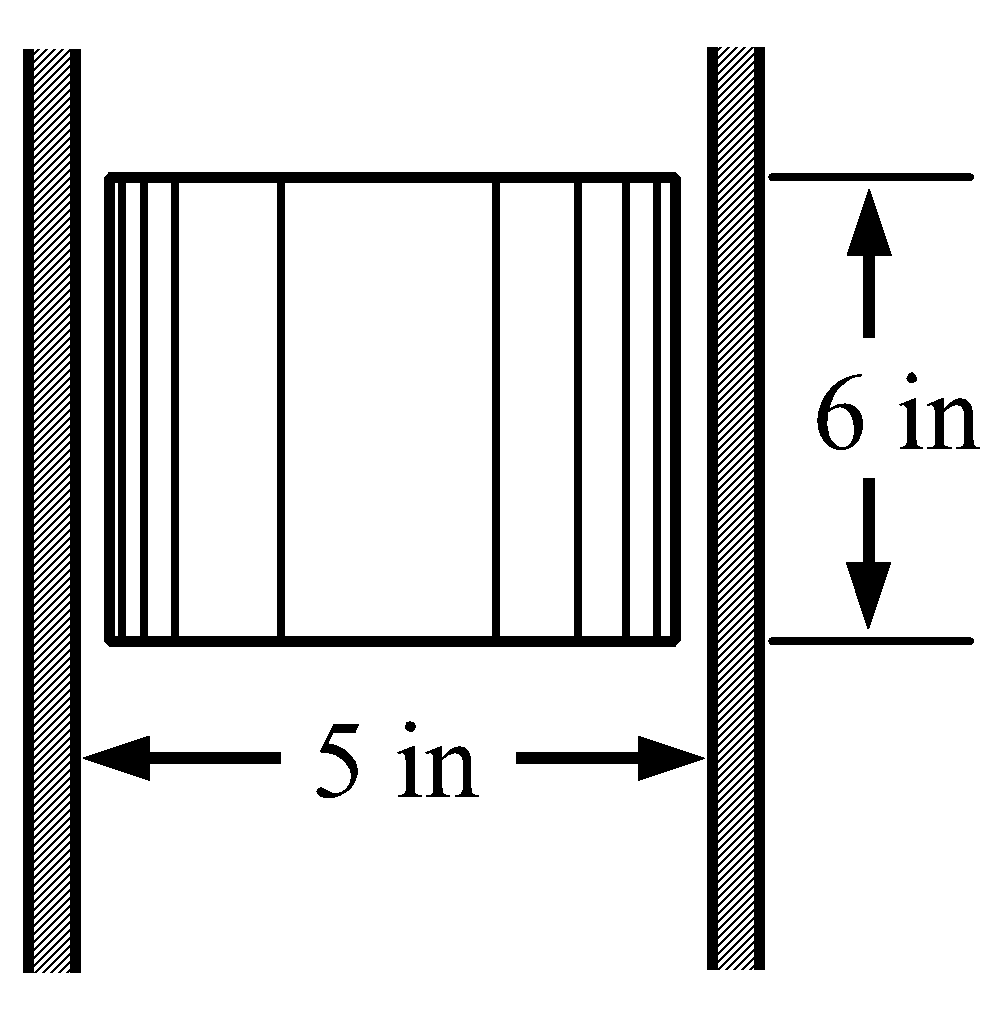
A piston of weight 21 lb slides in a lubricated pipe, as shown in Fig. The clearance between piston and pipe is 0.001 in. If the piston decelerates at 2.1 ft/s 2 when the speed is 21 ft/s, what is the viscosity of the oil?
Text Solution
Verified by ExpertsThe correct answer is:
A
Step 1: Determine the parameters given in the problem:
Weight of piston, W = 21 lb
Deceleration, a = 2.1 ft/s²
Speed, v = 21 ft/s
Clearance, h = 0.001 in = 0.001/12 ft = 8.3333 x 10^{-5} ft
Step 2: Calculate the area of the piston:
- Diameter of piston, D = 5 in = 5/12 ft
- Radius, r = D/2 = (5/12)/2 ft = 5/24 ft
- Area, A = \pi r^2 = \pi \left(\frac{5}{24}\right)^2 = \pi \cdot \frac{25}{576} = \frac{25\pi}{576} ft²
Step 3: Apply the Newton's law and the equation for viscosity:
The drag force on the piston due to viscosity can be expressed as:
\[ F = \eta A \frac{dv}{dy} \]
Where:
- F = mass * acceleration = W/g (where g = 32.2 ft/s², gravitational acceleration)
- Viscosity, \( \eta \)
- dv/dy = v/h
\[ F = \eta A \frac{v}{h} \]
Substituting for F and rearranging gives:
\[ \eta = \frac{F h}{A v} \]
Step 4: Substitute values into the formula:
F = (21 lb) / (32.2 ft/s²) = 0.651 lb mass.
\[ \eta = \frac{(0.651 lb)(8.3333 \times 10^{-5} ft)}{ (\frac{25\pi}{576}) (21 ft/s)} \]
Step 5: Calculate \( \eta \):
\[ \eta \approx \frac{(0.651)(8.3333 \times 10^{-5})}{\frac{25\pi}{576} \cdot 21} \approx 0.001218 lb \, s/ft²\]
Therefore, the viscosity of the oil is approximately 0.001218 lb s/ft², which corresponds to option A.
Weight of piston, W = 21 lb
Deceleration, a = 2.1 ft/s²
Speed, v = 21 ft/s
Clearance, h = 0.001 in = 0.001/12 ft = 8.3333 x 10^{-5} ft
Step 2: Calculate the area of the piston:
- Diameter of piston, D = 5 in = 5/12 ft
- Radius, r = D/2 = (5/12)/2 ft = 5/24 ft
- Area, A = \pi r^2 = \pi \left(\frac{5}{24}\right)^2 = \pi \cdot \frac{25}{576} = \frac{25\pi}{576} ft²
Step 3: Apply the Newton's law and the equation for viscosity:
The drag force on the piston due to viscosity can be expressed as:
\[ F = \eta A \frac{dv}{dy} \]
Where:
- F = mass * acceleration = W/g (where g = 32.2 ft/s², gravitational acceleration)
- Viscosity, \( \eta \)
- dv/dy = v/h
\[ F = \eta A \frac{v}{h} \]
Substituting for F and rearranging gives:
\[ \eta = \frac{F h}{A v} \]
Step 4: Substitute values into the formula:
F = (21 lb) / (32.2 ft/s²) = 0.651 lb mass.
\[ \eta = \frac{(0.651 lb)(8.3333 \times 10^{-5} ft)}{ (\frac{25\pi}{576}) (21 ft/s)} \]
Step 5: Calculate \( \eta \):
\[ \eta \approx \frac{(0.651)(8.3333 \times 10^{-5})}{\frac{25\pi}{576} \cdot 21} \approx 0.001218 lb \, s/ft²\]
Therefore, the viscosity of the oil is approximately 0.001218 lb s/ft², which corresponds to option A.
Prepare Smarter with CGP Edu
Get practice questions, solutions, and test series in one place.
Write a Review
Share your experience with this question and solution.
Commentary
Send your comment, doubt, correction, or feedback to admin.
Similar Questions
Explore conceptually related problems
The coefficient of viscosity for hot air is
A good lubricant should have
A small drop of water falls from rest through a large height h in air; the final velocity is
Water is flowing in a pipe of diameter 4 cm with a velocity 3 m/s. The water then enters into a tub…
A manometer connected to a closed tap reads $4.5 \times 10^{5}$ pascal. When the tap is opened the …
An incompressible fluid flows steadily through a cylindrical pipe which has radius 2r at point A an…